

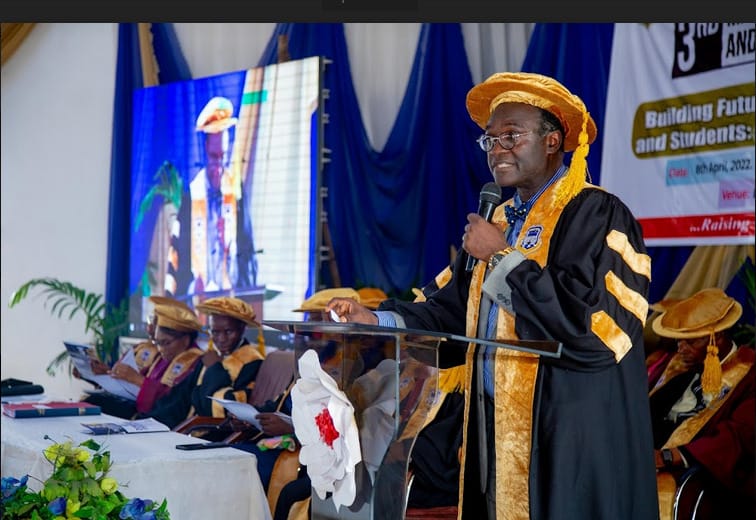
By Rotimi Agboluaje, Ibadan
The Vice-Chancellor of Bells University of Technology, Ota, Ogun State, Prof. Abel Olajide Olorunnisola, has called for increased funding of Nigerian universities, saying sustained investment in infrastructure, research, human capital and digital learning is critical to making the institutions globally competitive.
Olorunnisola made the call while receiving the Cred 360 Excellence in Educational Leadership Award presented to him by Cred 360 Media Limited, an IbadNigerian universities need funding to compete globally — Bells Varsity VCan-based media, public relations and advertising firm.
The organisation honoured the vice-chancellor for his contributions to university administration, scholarship and education, particularly during his tenure as Vice-Chancellor of Dominion University, Ibadan.
Olorunnisola assumed office as Vice-Chancellor of Bells University of Technology on August 1, 2026.
He said Nigerian universities had continued to produce graduates and professionals capable of competing successfully on the global stage despite the numerous challenges confronting the country’s higher education sector.
However, he identified inadequate funding as one of the major obstacles to the development and international competitiveness of Nigerian universities, urging the government to treat universities as strategic institutions essential to national development.
According to him, substantial investment is required to provide modern infrastructure, improve research capacity, strengthen human capital and expand digital learning, while competitive remuneration and conducive working environments are necessary to attract and retain quality academics.
Olorunnisola said Nigeria had demonstrated its capacity to produce world-class professionals, pointing to Nigerian doctors, engineers, software developers and other professionals making significant contributions around the world.
He noted that the performance of Nigerian professionals abroad was evidence of the enormous potential of the country’s universities, stressing that the challenge was to create the conditions necessary for institutions to fully harness that potential.
The vice-chancellor also advocated increased investment in digital infrastructure, noting that technology had fundamentally transformed teaching and learning. He cited the growing use of artificial intelligence tools such as ChatGPT, online videos and other digital platforms as evidence that lecturers must adopt more interactive and technology-driven approaches to teaching.
He said lecturers could no longer operate as though they were the sole repositories of knowledge, urging universities to create interactive classrooms where students could engage with information from multiple sources while technology was deployed responsibly to enhance learning.
Olorunnisola further stressed the importance of robust digital infrastructure, particularly in public universities, saying reliable systems could help sustain academic activities during disruptions such as industrial actions and pandemics, when students and lecturers might be unable to access campuses physically.
On the welfare of academics, the vice-chancellor expressed concern over the erosion of lecturers’ purchasing power, saying salaries had failed to keep pace with inflation and the rising cost of living.
He argued that improving the welfare of academics was essential to sustaining quality teaching, research and international collaboration, noting that lecturers needed an enabling environment to deliver effectively.
Olorunnisola also acknowledged the economic pressure on students and their parents, particularly those attending private universities, stressing that the financial burden extended beyond tuition to feeding, accommodation, transportation and other daily expenses.
He said universities must therefore strengthen their reputation, maintain discipline and distinguish themselves through quality academic programmes, infrastructure and human capital.
Speaking on his agenda for Bells University of Technology, the vice-chancellor said his administration would focus on strengthening the institution’s reputation, developing human capital, improving infrastructure and identifying areas that would give the university a distinct identity.
He stressed that no two universities should be expected to be exactly alike, saying each institution must determine what it wants to be known for and build its academic and institutional strengths around that identity.