
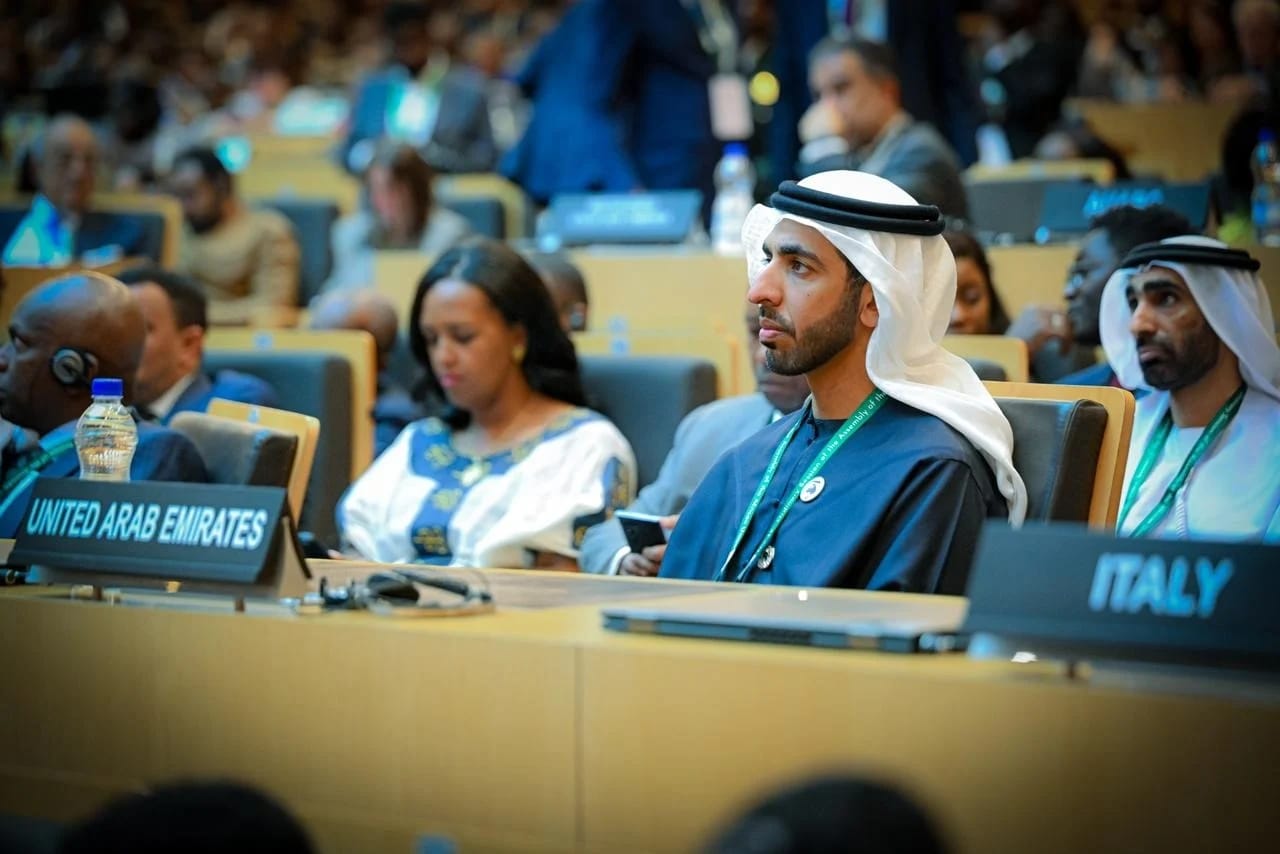
The United Arab Emirates has reinforced its economic and diplomatic engagement with African nations at the 2026 summit of the African Union held in Addis Ababa, outlining large scale investments, renewable energy expansion, and strategic trade cooperation across the continent.
In a statement issued on Sunday, the UAE said its Minister of State, Sheikh Shakhbout bin Nahyan Al Nahyan, represented the country at the summit alongside African heads of state and senior officials, where discussions focused on peace, security, economic integration, and sustainable development.
The minister noted that the UAE’s relationship with Africa is rooted in decades of trade and maritime connections across the Red Sea and Indian Ocean corridors, but has now evolved into structured, investment-driven partnerships. He highlighted the UAE’s expanding diplomatic footprint, with 19 embassies across Sub-Saharan Africa, as well as growing African diplomatic representation in the UAE, reinforcing its position as a hub for trade, finance, and dialogue.
Sheikh Shakhbout conveyed the greetings of UAE leaders, including President Mohammed bin Zayed Al Nahyan, Vice President and Prime Minister of Dubai Mohammed bin Rashid Al Maktoum, and Vice President Mansour bin Zayed Al Nahyan, expressing their wishes for continued progress and prosperity for AU member states.
Between 2019 and 2023, the UAE committed over $110 billion in investments across Africa , the highest by any single country within that period — with more than $70 billion directed toward energy, green, and renewable projects.
Under the Africa Green Investment Initiative, $4.5 billion has been mobilised to accelerate more than 60 clean energy projects spanning solar, wind, geothermal, battery storage, and green hydrogen technologies. Abu Dhabi-based renewable energy company Masdar is spearheading a $10 billion Africa programme, while the Etihad 7 initiative aims to expand electricity access to up to 100 million people by 2035.
Trade integration also featured prominently. The UAE has concluded nine Comprehensive Economic Partnership Agreements with African countries, including Nigeria, Democratic Republic of Congo, Sierra Leone, Gabon, Angola, Kenya, Congo-Brazzaville, Mauritius, and Central African Republic. Officials said the agreements cover tariffs, services, digital trade, and investment protection, and are designed to complement the African Continental Free Trade Area by strengthening cross-border value chains and competitiveness.
Infrastructure development remains a key pillar of cooperation. Global logistics firm DP World is undertaking a $1 billion upgrade of Dar es Salaam Port in Tanzania, while AD Ports Group has commenced construction of a new terminal in Luanda, Angola, to significantly increase container capacity.
Beyond commercial investments, humanitarian and development assistance remains central to UAE-Africa relations. Nearly 40 per cent of the UAE’s foreign aid , approximately $20.9 billion over the past decade has been directed to African countries.
Looking ahead, water security and climate resilience are emerging priorities. The UAE is set to co-host the 2026 UN Water Conference with Senegal from December 2 to 4, marking the first time two Global South countries jointly lead the global water process, in a move aimed at strengthening sanitation systems and advancing sustainable water security across Africa.
Observers say the summit engagement underscores a shift in UAE-Africa relations from traditional diplomacy toward long-term, investment led partnerships reshaping trade, infrastructure, and energy development across the continent.