
By Modupe Bankole
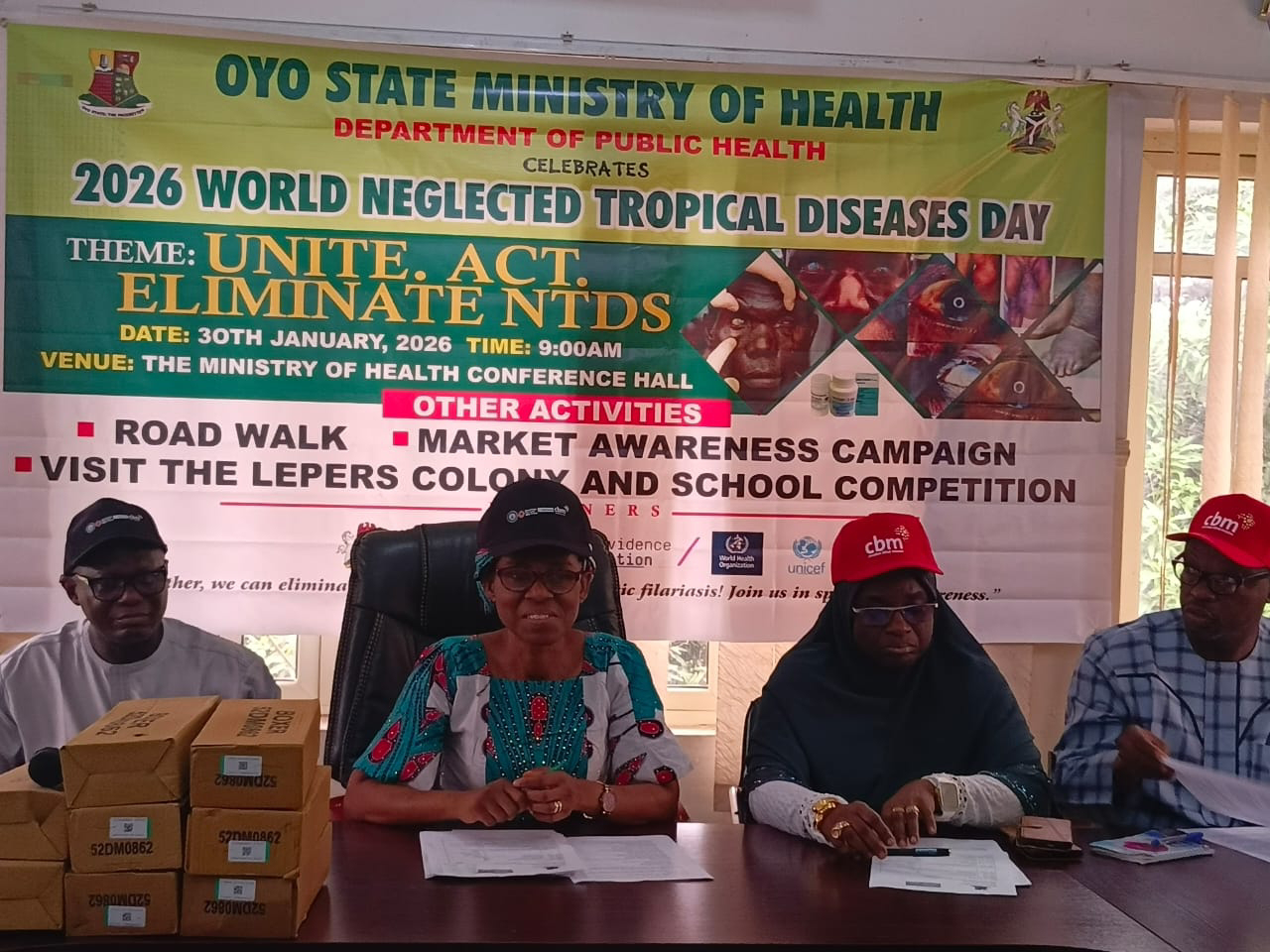
The Oyo State Government has intensified its drive to eliminate Neglected Tropical Diseases (NTDs) through renewed investments, strengthened partnerships, and improved last-mile service delivery, as it distributed eight motorcycles to selected Local Government NTD Coordinators during the 2026 World NTD Day commemoration.
The event, held on Thursday, January 30, 2026, at the Ministry of Health Conference Centre, Agodi, Ibadan, featured a press briefing by the Commissioner for Health, Dr. Oluwaserimi Ajetumobi, alongside a sensitization lecture titled “Breaking the Cycle of Neglect: Understanding and Combating Neglected Tropical Diseases” delivered by Dr. Ebunoluwa Adeoye.

Dr.Ajetunmobi said the intervention reflects the unwavering commitment of Governor Seyi Makinde’s administration to tackling diseases that disproportionately affect poor and underserved communities.
“World NTD Day provides us with an opportunity not only to commemorate this global observance but to take stock of our progress and reaffirm Oyo State’s commitment to the control, elimination, and eventual eradication of Neglected Tropical Diseases as a core component of our public health agenda,” she said.

She noted that NTDs remain among the most persistent drivers of health inequities globally, with about one billion people affected and over 1.4 billion requiring preventive chemotherapy or other interventions.
According to her, Nigeria bears one of the highest burdens, with over 200 million people at risk and about 165 million requiring preventive treatment—nearly 25 per cent of Africa’s total NTD burden.

The Commissioner disclosed that between 2025 and 2026, Oyo State recorded significant progress across prevention, treatment, surveillance, and community engagement.
“We successfully provided care for 77 persons affected by lymphatic filariasis-related elephantiasis across several LGAs, while 95 hydrocelectomy surgeries were carried out at Jericho Nursing Home and General Hospital, Moniya, with 58 of those procedures fully funded by the Oyo State Government,” she stated.

She added that targeted surveillance and mapping surveys were conducted in eight Local Government Areas to generate reliable epidemiological data for effective planning and resource allocation, while over 1,000 communities in Ibarapa East, Ona-Ara, and Egbeda LGAs were monitored under the Community Led Total Sanitation Plus (CLTS++) initiative to curb WASH-related transmission of NTDs.
Explaining the rationale behind the distribution of motorcycles, Dr. Ajetunobi said the move was aimed at strengthening field mobility and supervision, particularly in hard-to-reach areas.
“These motorcycles are being provided to Local Government NTD Coordinators, especially in LGAs with low coverage during the 2024 Mass Administration of Medicines. This will improve surveillance, supervision, and service delivery at the grassroots,” she said.
However, UNICEF’s representative at the event, Dr Emmanuel Orimoloye raised concerns over gaps at the Local Government level, particularly in patient identification, documentation, and continuity of care.
“While we commend the state government for its strong commitment, some LGAs are not doing enough in terms of proper surveys to identify people living with NTDs and ensure they receive adequate treatment and follow-up care,” the representative said, warning that without accurate data and sustained grassroots engagement, elimination targets may remain difficult to achieve.
Earlier in her sensitization lecture, Dr. Ebunoluwa Adeoye described NTDs as
“largely invisible diseases” affecting over 1.7 billion people worldwide and thriving in environments marked by poverty, poor sanitation, and limited access to healthcare.
“NTDs such as lymphatic filariasis, onchocerciasis, schistosomiasis, and intestinal worms cause chronic illness, disability, stigma, and economic hardship. Breaking the cycle of neglect requires awareness, stronger health systems, access to treatment, and sustained partnerships,” she said.
As part of activities marking the 2026 World NTD Day, a quiz competition was held for secondary school students, where three students each from St. Louis Grammar School and Bishop Philips Academy emerged winners. The outstanding students were subsequently unveiled as NTD Ambassadors at the secondary school level and given gifts souvenir with a mandate to help raise awareness and propagate information on the prevention and treatment of NTDs across schools and communities in Oyo State.

Dr. Ajetumobi commended Local Government Chairmen, religious leaders, Ward Development Committees, and development partners including UNICEF, WHO, CBM International, and Evidence Action for their continued support, stressing that the elimination of NTDs requires collective action.
Speaking under the global theme “Unite. Act. Eliminate.”, the Coordinator of Christian Blind Mission (CBM), Dr. Ebunoluwa Adeoye, called on stakeholders, the media, and communities to sustain momentum and close existing gaps.
“Together, we can ensure that no resident of Oyo State suffers needlessly from preventable and treatable neglected tropical diseases,” she said.