

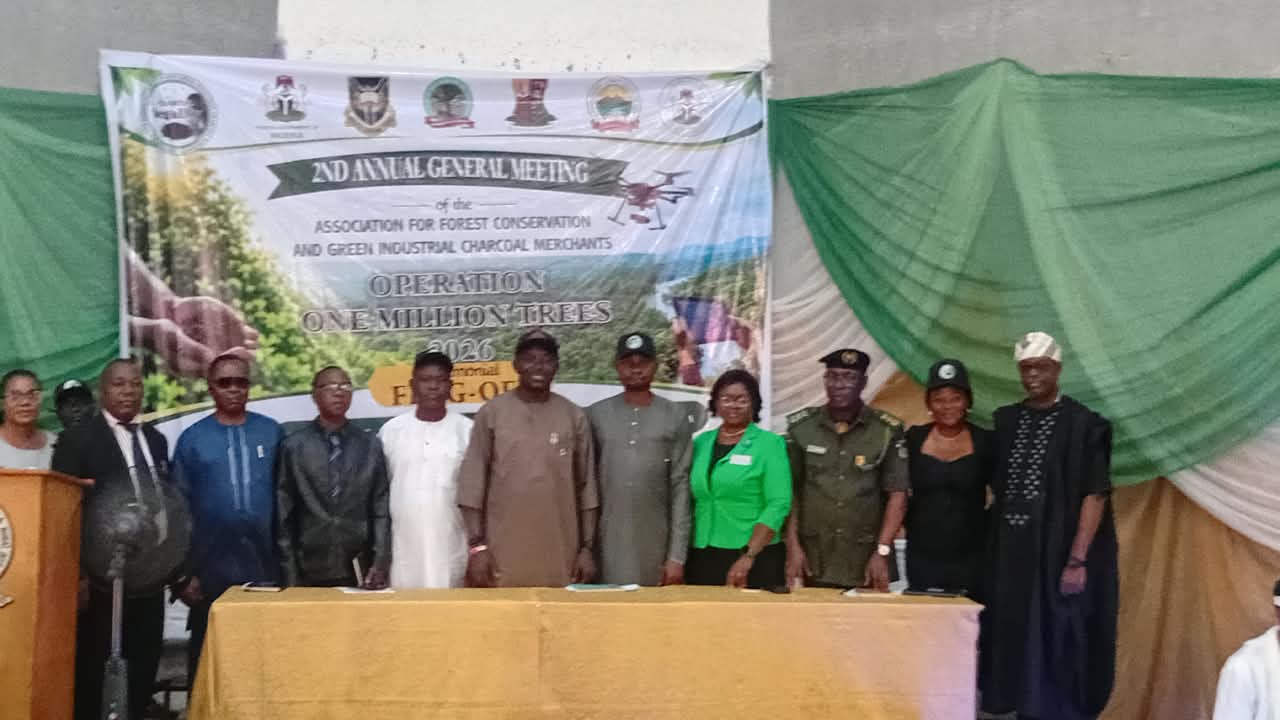
The Federal Government and the Oyo State Government have thrown their weight behind the 2026 Operation One Million Trees initiative, raising concerns over the potential impact of worsening environmental degradation, with projections of a global waste-management crisis within 15 years and a severe climate crisis within two decades if urgent action is not taken.
The initiative, spearheaded by the Association of Forest Industrial Charcoal Merchants, was officially launched on Wednesday at the First Bank Building, Faculty of Agriculture, University of Ibadan, under the theme, “Technology-Driven Solutions for Forest Protection.”
Speaking on behalf of the Minister of Environment, Balarabe Lawal, Dr Elonusa Osakwe, who inaugurated the programme, stressed the need for collaborative efforts involving government institutions, academic communities, civil society organisations and local communities to safeguard Nigeria’s natural resources.
Osakwe noted that environmental sustainability could not be achieved through government efforts alone, calling for greater involvement of young people and students in environmental conservation.
He also praised the organisers for their commitment to environmental protection and the advancement of sustainable development goals.
In his remarks, the Oyo State Commissioner for Environment and Natural Resources and chairman of the occasion, Ademola Aderinto, described climate change as a challenge with far-reaching global consequences.
He warned that the world could experience a major waste-management crisis within the next 15 years, followed by a more severe climate crisis within 20 years if existing environmental practices remained unchanged.
Aderinto identified uncontrolled tree felling for construction, housing and commercial activities as a major contributor to environmental degradation, with serious implications for biodiversity and food security.
He called on residents and property developers to embrace tree conservation and ensure that more trees were planted whenever existing ones had to be removed.
According to him, replacing a felled tree with just one seedling is no longer sufficient, urging people to plant two or more trees in its place.
The commissioner further encouraged developers to incorporate existing trees into building designs wherever possible, rather than clearing vegetation unnecessarily.
He also urged residents to make tree planting a regular practice by cultivating trees in their homes, workplaces and other frequently visited locations.
Earlier, the Dean of the Faculty of Renewable and Natural Resources, Professor Adejoke Akinyele, said the initiative’s second year reflected the faculty’s commitment to translating the United Nations Sustainable Development Goals into practical environmental action, particularly in the area of climate change mitigation.
The association’s chairman, Idowu Adeshola, alongside its partners, including Florence Omolola of FOJ Multidynamic and Azeez Rasaq of Rasbat International Resources Limited, explained that the programme was also aimed at encouraging sustainable charcoal production and ensuring compliance with regulations issued by the Federal Ministry of Environment.
They disclosed that modern technologies, including drone-assisted seeding, would be incorporated into the initiative to increase tree-planting coverage and strengthen forest conservation efforts.

The event attracted representatives of the Federal Ministries of Industry, Trade and Investment; Education; and Science and Technology, as well as the Conservator-General of the Federation and other stakeholders in forestry and environmental management.